Saturday, 25 February 2012

It's a small world after all...

Greetings from Kampala! I am in town for my second weekend off, this time in the capital. I forgot how overwhelming Kampala can be after spending a month in a rural community and then Jinja, which is not nearly as busy. In any case, I am happy to have a day or two to relax and reflect on the last month. I am now 1/3 through with the program, and have four months of work to go, although we have a holiday and five days training in April so it won't be as busy.

Work is proceeding well. The last two weeks were more or less the same as the first. We still had baseline surveys to complete, although we started to do some more activities as well. As a livelihoods volunteer, I spend a little bit of time in schools, but a lot more time with our out-of-school youth groups. We have done some sessions on club development and management as well as entrepreneurship. I think that things will really pick up in March. We have a ton of targets to work towards, and will be doing a session almost daily. As well, the rainy season is starting, which means that people start planting their crops. Our team is planning a demonstration garden near the house, where we can instruct people on how to use different techniques for organic farming. My team partners have promised to teach me to dig like a Ugandan, and I even bought rainboots this weekend so that I will be well prepared for garden work. I'm a bit nervous but really willing to learn, so I hope that it goes well.

I am also starting to get used to day-to-day living in Busaana. I have been making friends with some of the locals. The kids near our house help me to pump water sometimes, and I have been getting better at cooking some Ugandan food. There is no electricity in the village, but the government has recently been putting up the wires to get it started. The main source of electricity in Uganda is hydropower from the Nile, and it is really starting to expand into the more rural areas.The community volunteers that it may even be switched on sometime in the next month or so, and I am really interested to see how this changes things, if at all. I am getting really used to reading by oil lamp and head torch, and I doubt that this will change as Restless Development volunteers are not the first priority for service delivery!

Another thing that I have to get used to is the teamwork. Things move a lot more slowly in Uganda, even though we have a lot to do, and communication is sometimes difficult as things get lost in translation between cultures. I feel like this is one of the most interesting parts of development - I know that I could get a lot more done by myself, but I feel that we really need to do things as a team if the work is going to be sustainable, especially where the community volunteers are involved. This can be frustrating at times but throughout the month we have improved, so I am still optimistic. Change is really slow and difficult to achieve, especially when it comes to more abstract subjects like 'empowerment'. I think that sometimes all we can do is give people information, so that a few people can act on it. One of the questions we had to ask in our focus group discussion (one of the baseline tools) was about gender-based violence, and the participants turned the question on us by asking what we thought they could do to prevent it. This came after a really discouraging discussion about the persistence of gender inequality, and made me feel like we are getting somewhere, if only little by little. The more I talk to people in the community, the more I see that there is so much false information out there, mostly because there is nowhere to get any accurate story. Knowledge in this case really is power.

March is going to be really busy, but I hope to get a couple more blog posts up to let you know how the real work is going. I am planning another weekend in Jinja at least, so stay tuned.

Cheers,
Lauren

P.S. The title of this blog post refers to the disney song of the same name, which is played constantly in Busaana by the "ice cream truck", which is a motorcycle with a box on the back. I am not brave enough to try the ice cream (the travel health guide says no to dairy!), but I am serenaded almost daily. The only other song they play is "My Heart Will Go On", but I didn't think that one would make as good a title... lol.

P.P.S. As promised, here are some pictures.


My placement team. Left-to-right: Alex, Clare, Agnes, Fred, and Me!
 
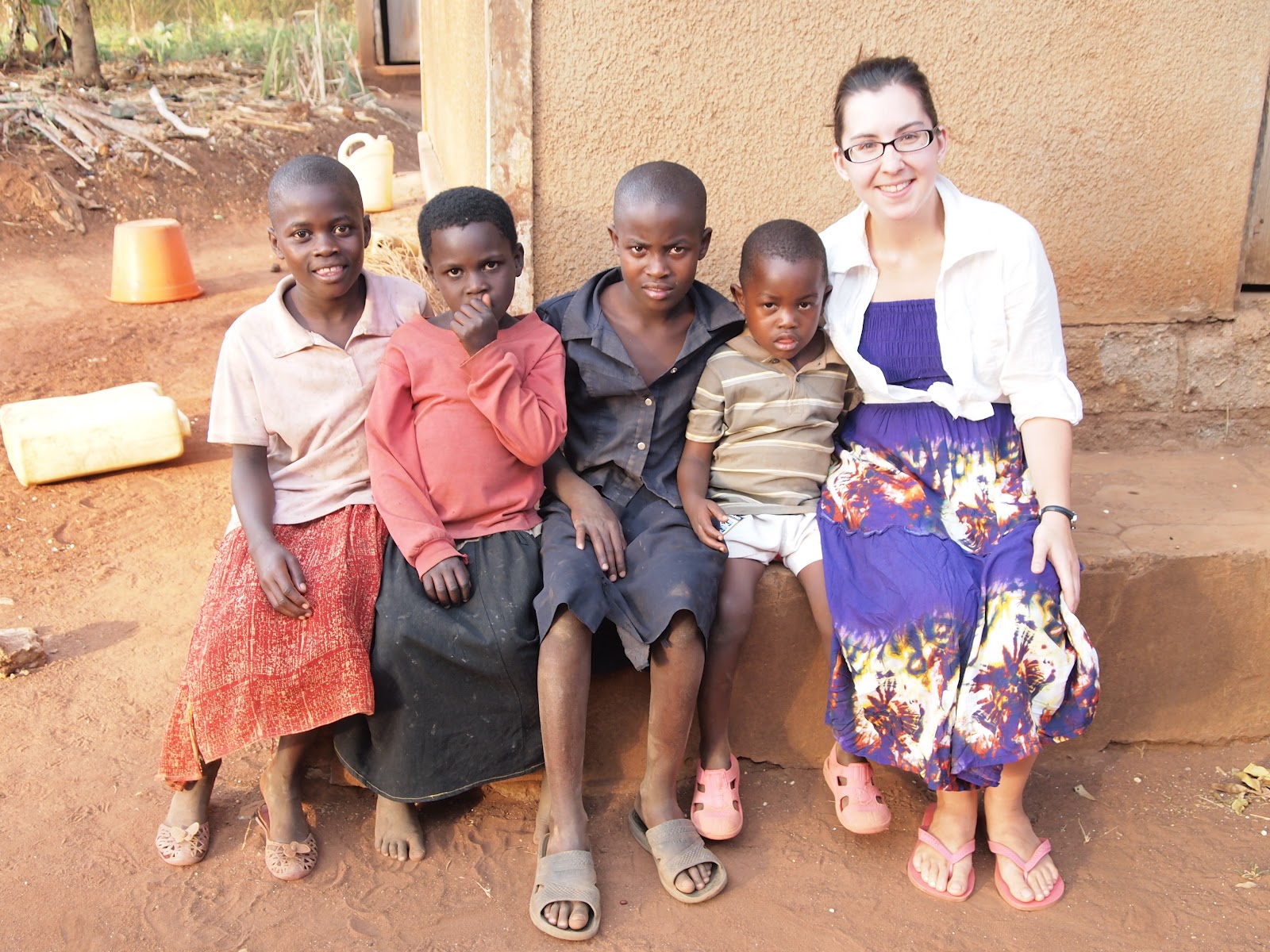
My friends in Busaana.

Where we live... only we have a little room at the back.

The kitchen.


The bedroom - where Clare and I stay.


Sunday, 12 February 2012

First two weeks in Busaana

Hi again. I am writing from Jinja, on my first weekend off from placement. It is really nice to have a bit of a break from bucket showers and latrines, and to see some people from other placements. However, now that I have started work, I think I should tell you all about it.

We arrived in Busaana on January 31st, in the afternoon. There are no paved roads beyond Kayunga town, so the last part of the drive was really dusty. That is one constant in Uganda, and especially in rural communities - the dust is everywhere. I'm sure that I will come back with red dust coming out of my pores. Busaana is no exception - we sweep our room all the time, and somehow the dust just gets back in every day. The place we are staying is alright. We have one room at the back of the police station, so it is very safe. The room served as last year's youth resource centre when Restless Development was working in Busaana, but since they couldn't find another place for us to stay, we are living in it for the time being. This means that our room is decorated with posters having to do with sexual reproductive health! On our walls you can learn about how to use a condom, or even some relationship advice for young people - "show your girlfriend love by helping her carry a jerry can".

The toughest part of living in Busaana has been adjusting to the day-to-day routine. I shower using a bucket, and have to carry my own water to do it. We cook on a small charcoal stove, eating mostly rice, plantains, and beans. The latrines are probably the least enjoyable part, and I know that I will not miss them at all. There are also some improvements from training. I am eating a lot of fruit - every day we have jackfruit, sugar cane, or the occasional pineapple. My placement partners are continually surprised when I tell them that these things do not grow in Canada, and they don't really get it when I explain that Canada has no national cuisine. It's a hard thing to explain.

Work has also been going pretty well. So far, we have been doing a lot of surveys and assessments, so that we can get to know the community and plan our work around what is most needed. We have been going to various schools, local government officials, youth groups, and religious institutions to introduce ourselves and the organization. This is the second year that Restless Development has worked in Busaana, so we still have some groundwork to do.  I am one of the only 'muzungus' in Busaana (so far the only other is an American missionary named John, who is based in Jinja), so people are really interested in talking to me. Some have asked for things or money, but as a volunteer representing Restless Development, I can't do anything about that because it would set a bad precedent for future volunteers and also sends mixed messages to the community about what we are there to do.

I have also been doing some more informal assessments on my own, trying to observe and learn from what is around me. The most shocking thing that I learned was that child sacrifice still occurs in Uganda - this was from an NGO poster in the headmaster's office at the primary school. I'm not sure what work is being done to stop this, but it is definitely something that needs attention. The other main thing that I have noticed is gender inequality. This has shown up in our official assessments as well, as we have done some testing with young people in and out of school. Some manifestations of gender inequality are quite obvious. For instance, women here will sometimes kneel to greet men, even in the dusty roads. While I knew that polygamy was common in Africa, I was quite surprised to learn that some of my colleagues are polygamous themselves. One of the volunteers on my team has three wives! It has been difficult to hold my tongue in some circumstances, but I am trying my best to be respectful and learn more about cultural practices in the community, and also explain that this is not the case in Canada. I'm really interested to see how the community will react to some of the sessions we will be holding on things like gender and relationships, and I will make sure to write more about this as I continue working.

I have to catch my bus back to Busaana (there are only a couple each day), but I will be back in two weeks with another update.

Cheers,
L

P.S. Will post photos the next time, as the internet is too slow this time around.

Monday, 30 January 2012

Training comes to an end...

Time has flown by since my last post. Today was the very last day of training, and tomorrow I am headed out to my placement. I have a lot to share about the training experience.

Training has been very intensive. As a "Livelihoods" volunteer, my focus is to give young people skills and knowledge so that they are able to start their own businesses and become self-sustaining. Youth unemployment in Uganda is as high as 80%! In a country where over 75% of the population is under the age of 30, this is a huge problem. So, in training, we learned to conduct sessions in basic entrepreneurship skills and life skills, project proposal writing (so that young people are able to access loans and funds from banks, government programs, and savings and credit cooperatives), and even things like group management. As part of livelihoods training, we also got to practice some organic farming methods, and we visited a local organic farm to see just how it is done. The farmer we met, Dorothy, even generates her own electricity using biogas from cow manure! It was really really cool.

Beyond supporting youth livelihoods, another one of of Restless Development's goals is to increase young people's civic participation. To this end, we discussed things like gender and advocacy, and learned how to manage the youth resource centres we will be setting up and supporting in our communities. Finally, our training included some sessions more relevant to the administration part of our work, like finance or monitoring and evaluation. These things are really important, because they provide the organization with data so that they can show impact and further advocate for young people based on our results. As part of this, we learned about Participatory Rural Appraisal techniques, which allow us to collect information from our communities so that we are using people's existing knowledge and skills to design our sessions and programs. I know that I am getting into the more technical side of things - so I promise to dedicate a whole post to this at a later point. (For those interested in PRA, look up Robert Chambers from the University of Sussex' Institute for Development Studies. While I was at LSE, my department was lucky enough to have a whole day's workshop with him, learning about PRA and rural development work).

An amazing session we had with the TASO Drama Group. (TASO = The Aids Support Organization. All of the performers are living with HIV).
Besides training, I have also been having some fun. So far, I have been to Kampala twice on the weekends. The city is unlike anything I've ever seen before, but is really cool. We went to Owino market, which is much like the rural trading centres but on a massive scale. There are people everywhere, selling goods of all kinds. I also had the chance to try some Indian food in Kampala, which was really amazing. There is a very large Indian community in Uganda, and they have a long and tumultuous history here as Idi Amin (Uganda's infamous dictator who ruled in the early 1980s) forced them out of the country and appropriated many of their assets. Ugandan cuisine itself has been partly influenced by Indian food - you can get a chapati at any street market, for instance. Overall, it has been really fun to see Kampala, as it is quite different from rural life. I hope to be back on some of my weekends off.

Kampala.

The Ugandan Parliament building, in Kampala.
As training is winding to a close, I am getting more excited and a little nervous about placement. I will be going to Busaana sub-county, in Kayunga district. I am working in a team of five - it will be myself, Clare (a national volunteer), and Agnes, Alex, and Fred (all community volunteers). Clare and Agnes will be focusing on sexual and reproductive health, while Alex, Fred, and I are doing livelihoods. All of us will be working together on civic participation and ensuring that our events, lessons, and sessions are a success. I don't really know what to expect, but the community volunteers have told me that I will really enjoy living in Busaana. There will be some challenges for sure - continuing to learn Luganda, having to cook and fetch water - but I am really looking forward to the work. I think that we will make a good team!

I move out tomorrow! I will once again have to find the nearest place for internet access, but I promise to update as soon as possible. We all get two weekends off per month, so I will be able to go into town at least a bit regularly.

I hope that everybody is doing well, and that 2012 is off to a great start.

Cheers,
Lauren

Monday, 9 January 2012

Week 1 in Uganda

I made it!

After my last post, I met up with the other international volunteers in Heathrow. Together we flew to Nairobi and then to Entebbe. We landed in Uganda in the morning, cleared customs and were met by Restless Development staff, who drove us to a supermarket where we bought cellphones and some fruit. We then drove straight to where we will be living for the next month, which is the Kasenge Riverford Organic Training Centre near Mbalala. Normally the facility hosts people who come to learn about sustainable organic farming techniques, and there is a large garden. Some of the food we eat comes from there. This month, however, they are hosting 70 Restless Development volunteers as we train for our placement.

The training started right away. We arrived on Monday mid-day and started our sessions on Tuesday morning. We train 5 and a half days a week with only Saturday afternoons and Sundays off. There are 14 international volunteers (from Canada, the US, the UK, Germany, Australia, and New Zealand), and the rest are Ugandan. We are all roughly the same age and education level. The sessions have been a learning experience. On top of trying to get a hang of all the material we need to know to do good work in placement, we are learning more and more about Ugandan culture and the way that things work over here. The time not spent in session still involves learning, as I have to find out what the food is called (I am new to matoke and posho among other things), how to haggle over prices in the market down the road, and even how to wash my laundry (including sheets!) by hand! 

My first impressions of Uganda are good. The countryside is green and beautiful, and yesterday we even took a trip to see the source of the Nile. There are a lot of things which are much more difficult than in Canada - the power regularly goes out where we are staying so you have to plan when to charge your phone, for instance. Showers are very cold! However, I knew when I signed up for this program that I would be in for a challenge, and I am here to learn as much as I am to help.

Stay tuned for another update. Internet access is sparing and slow, but I am going to try to get to a cafe every couple weeks or so.

I hope you are all doing well. Thank you so much again for supporting me in this journey, and I miss you all!

Here are some pictures to give you an idea of what I am up to: 

The training centre.
The market down the road from the training centre.

Some of the other volunteers at the market.
At the source of the Nile... (that's me on the left).


 Love, L

Sunday, 1 January 2012

Departure

Hello and Happy New Year to all my wonderful friends and family,

I'm off!
... and this is in no small part due to your support throughout the fall. I feel very lucky to be surrounded by such wonderful people. I would like to give a sincere thank you in particular to those who supported my fundraising efforts. Please remember to send me your addresses so that I can write you a letter from my placement.

Having spent New Year's Eve in the air, I am writing this from Heathrow. The next stop is Nairobi, followed by a very early morning flight to Entebbe. I meet up with the rest of the Restless Development group in a few hours, and it will be so great to finally meet everyone in person. While this is 'officially' the first leg of my journey, I have felt 'unofficially' on my way since early in the fall as I began the process of fundraising, preparing my supplies, getting injections, and studying up on Uganda and the work I will be doing. It seems so unreal to finally be on my way. I am feeling very excited to get there and I am also extremely proud of my packing and what I think is actually a fairly reasonable amount of luggage for 6+ months. I am not known for being a light traveller so this is a big achievement. I could hardly sleep at all on the flight to London and I am hoping that I can rest up on the next leg as I will be hitting the ground running. We start training after only a day's rest, and I feel like everything will move quickly from there. 

Please keep reading, and I will try to update this blog as often as I can. I hope that you all have a fantastic start to 2012.

Love,
Lauren

Wednesday, 2 November 2011

Uganda - Lesson 1

Hi again! It has been a few weeks since my last post, but I have been hard at work getting ready for my departure. Here is a snapshot of my preparation in numbers:

2 - months until I land in Uganda
19 - days until my first half marathon (!!)
21.1 – kilometers I will be running in the half-marathon
16 – kilometers in my latest long run
2 – days of first aid training
380 – number of pages in the Luganda language textbook I have been studying
20 – approximate number of words I can say in Luganda so far without my notes
5 – number of immunizations I have already received (more to come)
50 – percent of my fundraising goal that I have raised so far
3 – blog posts written (including this one)
6 – passport photos I sent to Restless Development in London to get my Uganda visa

Everything is really coming together.

BUT, there is one thing about preparing for this trip that I did not fully anticipate, which is the…

1 million – questions I have received about Uganda! Is it safe? Where is it? Isn’t that where Idi Amin ruled? What are the politics like? What about HIV/AIDS? Where did you say it was again?

I believe that an important part of doing development work is learning about the country and culture where you will be working. So, in an effort to both prepare myself and better answer these questions, I will be doing a series of blog posts about Uganda. This first post will cover the basics.


10 facts about Uganda*

1. Uganda is located in East Africa, north of Lake Victoria. It shares a border with South Sudan, Kenya, Tanzania, Rwanda, and the Democratic Republic of the Congo.

2. The country’s population is 34.6 million. The population is the second youngest in the world, with around 50% of the population under the age of 14 and 78% of the population under the age of 30. This begs the question: why are young people so often excluded from development?

3. Uganda’s per capita GDP is $1,300. By comparison, Canada’s is $39,400.

4. Yoweri Museveni, the current president of Uganda, came to power in 1986. The country was a one-party state until a referendum reintroduced multi-party politics in 2005.

5. Uganda faces international pressure for its conduct in both internal and external conflicts. The international community has criticized the Museveni government for its involvement in the DRC throughout the 1990s and early 2000s, as well as its handling of its own civil war with the Lord’s Resistance Army in the northern part of the country.

6. The country has many characteristics common in developing countries, including high maternal mortality and infant mortality. The fertility rate in Uganda is the second highest in the world, with 6.69 children born per woman. I can’t even imagine having six kids!  This means that the population size in Uganda is projected to nearly triple from 2010 to 2050.

7. Only 13% of the population in Uganda lives in an urban centre. Even though urbanization is on the rise, the country has the 3rd most rural population in the world.

8. Ugandans suffer from HIV/AIDS, although the prevalence of the disease has declined in recent years. Around 6.5% of the adult population directly suffers from HIV/AIDS.

9. Despite strong economic growth in recent years, youth unemployment in Uganda is a staggering 80%. With a rapidly growing working age population, the country will need to drastically expand its economy.

10. Restless Development has been working in Uganda since 1997. They have conducted 15 years of youth-led development work, reaching over 200,000 young people.


Alright, so now you have the basics, and we all know a little bit more about the geography, history, politics, economics, and population characteristics of Uganda. However, if I learned anything in my many years of schooling, it is that facts alone do not tell the whole story. So, until I leave, I will be writing about different aspects of Uganda and how this all relates to development and the work I will be doing. 

Finally, don’t forget that I am still fundraising and I need your help! I would love it if you would sponsor me to run my half-marathon on November 20th. Please visit my fundraising page or see me in person. 

Cheers, and keep reading. 
L


*Sources: Restless Development, BBC, CIA World Factbook

Wednesday, 12 October 2011

Why Restless Development?


Now that I have introduced myself, it is time that I introduce Restless Development. This is the organization that I will be working for while in Uganda. A lot of you are probably wondering why I chose this organization over the many others that offer international opportunities, why I chose to volunteer my time as opposed to looking for a job, and what I am actually going to be doing on the ground. This post will answer these questions, and hopefully persuade you to support me on my journey to Uganda!

One of the challenges of doing a one-year masters degree was having to worry about what I was going to do afterwards. I felt like I had already been through a similar process in the last year of undergrad. This time, however, I knew that I wanted to get some experience working in a developing country. Despite my love of studying development and contemplating these issues in papers, conferences and Model-UN simulations, I was feeling a bit restless. It was time to (finally) leave academia and tackle things in the real world.

Looking for a job in development, however, can make anybody a bit crazy. You need experience to get experience! You need experience plus a sub-sub-sub-specialization in creating rural, small-scale, gender-mainstreamed, income-generating, organic agriculture projects! Want to work for the UN? Well, they aren’t hiring nationals of your country this year! You want paid field experience too? Good luck with that. Before giving up completely and switching my MSc degree to something 'practical' like finance (the ‘other’ side of the LSE), I decided to attend the international volunteering fair up at SOAS.

I have long been skeptical of volunteer abroad programs, so I went into the fair with low expectations. After all, I was going to have a Masters degree in Development. I couldn’t justify paying money to spend three weeks in a developing country to do a job that could easily be done by somebody who lived in that country and needed paid work (like construction, which is a focus of a lot of these projects). I wanted something that would give me a longer period of relevant experience and hopefully some training so that I could one day get one of those elusive development jobs. I also wanted to do something that would let me use some of the skills I already had.

Then, I found Restless Development. I talked a bit to the young woman behind their table, but in the chaos of the volunteering fair I didn’t really make a decision to apply with them until I started researching the organization in my own time. The more I found out, the more I liked what they had to offer.

First, youth empowerment is one of the most important issues in the world today. The Arab Spring can arguably be attributed to the restlessness of youth fed up with not having their voices heard. Young people also make up a huge percentage of the world’s population, and are concentrated in developing countries where unemployment is high. Restless Development tackles this issue by giving young people the knowledge and skills to participate in policy-making processes and make informed decisions about their reproductive health and livelihoods. 

Second, Restless Development offered me a chance to use my skills. As an International Volunteer Peer Educator, I will play a direct role in delivering information about reproductive health and livelihoods to young Ugandans by running workshops, setting up and supporting youth clubs and resource centres, working on community outreach and organizing public events. I spent a lot of my time in university organizing conferences, chairing meetings, and helping other young people get informed and get involved. These were all things that I could do again but in a different context. As well, all Restless Development volunteers get a month of training at the start of their placement, and all of us do the monitoring and evaluation of our projects. On top of learning to fundraise, this experience is invaluable in the development world.

Finally, I chose Restless Development because their methods speak to the quality of their work. I really love the fact that Restless Development uses not only international volunteers, but nationals and locals as well. This means that in Uganda, I will be working with young Ugandans who can ensure the sustainability of our projects and continue to be leaders in development in their own country. I know that while I won’t radically change the world in six months, I will learn from and share my experiences and ideas with young people who affect policy today and will continue to do so in the future. This isn't just empty optimistic rhetoric - last year, Restless Development led a group of youth-focused organizations to develop the country's first ever Youth Consultation on the National Development Plan. Six of their twelve recommendations have actually been included in the new national plan, and trained youth leaders are monitoring the plan's implementation. 

I am embarking on this experience hoping to contribute, but expecting to learn a lot as well. Keep reading to find out what my perspective on development is like going into Uganda, and how it changes.

L